Global Sync # 9
Kamala in Context | DragonBear | Ukraine's Oppenheimer Moment | Nature & Fascism | Red Pills & Aha Moments | Called It
Welcome to Global Sync, a newsletter on geopolitics made simple. Today we’re talking about Kamala Harris’ historical antecedents, the human dimension of the China-Russia alliance, Ukraine in Kursk, fascism and nature conservation, and spotting asymmetries.
If you’d like to sign up to receive issues over email, please subscribe. Thanks for reading!
Global Sync #9
Today is the 25th of August, 2024. Here are 5 things I think are worth knowing about the world this week.
1/ HISTORY: Kamala in Context
World History is full of repeating characters. One of the best is the unassuming deputy who comes from nowhere to gain power and change the world forever. Harry Truman. Justinian the Great. Anwar Sadat. Deng Xiaoping. Joseph Stalin. Each were transformational figures fatally underestimated by the status quo and assumed to be weak and out of their league. Each ascended during times of great change and transition. Each were bold - and lucky - enough to meet their moment, recognizing opportunities and taking advantage of them at the right time and place. I was thinking about these threads of history as I watched Kamala Harris’ stirring and well constructed speech to the Democratic National Convention this week. Kamala’s sudden ascent to power, albeit yet neither certain nor complete, is coming at a time in American history and global politics where the old ways, and the old men, are being thrown out with increasing frequency and vigor. If she is able to rise to the throne and the fates otherwise play along, I believe America and the world could be hers to remake, that is, if she’s cunning and courageous enough to do so.

2/ LANGUAGE: DragonBear & Totalitarian Bromance
The new era of geopolitics has a new language. One of my favorite new terms is “DragonBear,” coined some years ago by Vienna-based Bulgarian strategist Velina Tchakarova to describe the budding and potentially world-changing alliance between China and Russia. Language is a key aspect of power, framing what about a problem we are able see. I think ‘DragonBear’ nicely visualizes the inherent tension and permanently mismatched relationship between these two totalitarian powers and, importantly, the men who lead them.
Realists tend to see DragonBear as a rational byproduct of shared interests, in particular a common aspiration to challenge US power. But I think this interpretation is too limited, leaving out the huge human and psycho-emotional aspects of totalitarian systems. Totalitarian leaders rule through dehumanization. The only humanity they recognize is their own, with one exception: other autocrats they consider as peers. These ‘totalitarian bromances’ are an unruly mix of love, hate, jealousy and admiration. They also typically have a powerful double asymmetry to them - one country more powerful than the other but, counterintuitively, the leader of the weaker country an inspiration to his supposedly stronger counterpart. Think Hitler (powerful) and Mussolini (inspiration). Trump and Kim. Xi and Putin.
I think ultimately one cannot understand ‘DragonBear’ without understanding ‘Totalitarian Bromance’. China is the great power that Russia aspires to be. But Putin is the iron leader that Xi wishes he already was.
3 / INNOVATION: Ukraine’s Oppenheimer Moment in Kursk
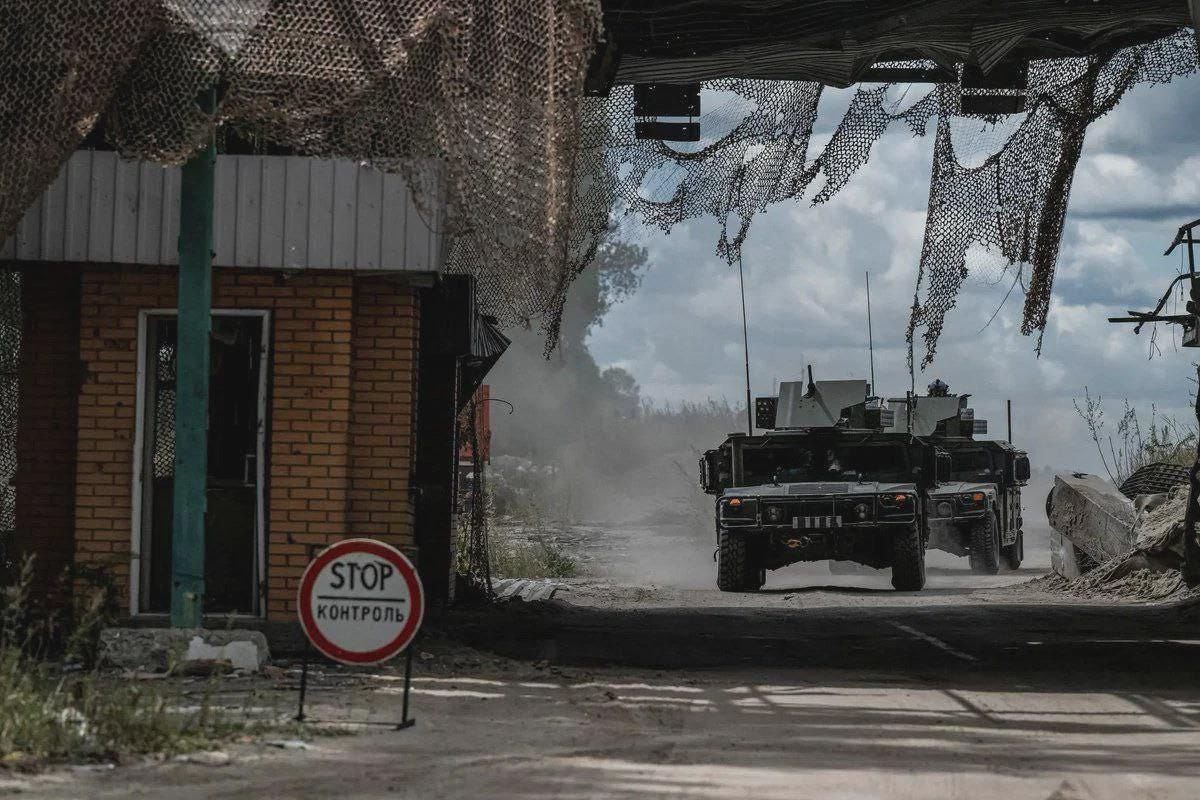
I’ve been reading as much as I can about Ukraine’s offensive into Kursk Oblast, so far a huge humiliation not only for Putin but also European and American proponents of restraint and incrementalism. In World War II, Kursk was the site of the biggest tank battle in history, involving some 6,000 tanks and 2 million troops. Today’s operation included as many as 30,000 soldiers and 600 tanks on the Ukrainian side (no numbers yet available for Russia). While its exact outcome and import is still to be determined, Ukraine’s Kursk operation seems to be the first time in human history that an army has fully integrated drones and artificial intelligence (broadly defined) into conventional maneuver warfare. Some commentators have called this an “Oppenheimer Moment” where the introduction of a technology - the long bow, the gatling gun, nuclear weapons, unmanned robots - changes the contours of war forever. We will see. Read more in the links below.
4/ BOOKS: The Green and the Brown
I came across a disturbing and fascinating book, The Green and the Brown: A History of Conservation in Nazi Germany, by German historian Frank Uekötter. The book chronicles how the Nazis put nature conservation at the center of their ideology and how German environmentalists in turn welcomed the Nazis first as opportunistic allies and then as full partners. It was, Uekötter writes, a story of “ideological convergence, of tactical alliances, of careerism, of implication in crimes against humanity, and of deceit and denial after 1945.”
I think this history is critical for today’s environmental movement. It goes to some fundamental debates about how best we protect nature:
Enforcement vs. Justice
Compliance vs. Autonomy
Useful lies vs. Inconvenient truths
Alliances of the powerful vs. Bottom-up solidarity
Elimination of threats vs. Compounding of victories
Authoritarian effectiveness vs. Democratic inefficiency
We environmentalists like to think that there is an inherent distinction between ‘People and Planet’ and ‘Blood and Soil.’ But maybe this difference is not as automatic as we would like to believe.
5 / FILM: Red Pills and Aha Moments
It ain't what you don't know that gets you into trouble. It's what you know for sure that just ain't so. - Mark Twain
We all have experienced it. A moment where we realize that a long held assumption, belief or expectation is not true, maybe even an outright lie - even an intentional one told by someone we trust. A moment that causes us to question bigger things, possibly the whole system. I rewatched the film The Big Short last week and reflected a lot on the processes by which we challenge long held beliefs and the status quo.
In the right wing and conspiracy theory world, this is called this ‘Red Pilling.’ In more polite society, we’d call it an ‘Aha Moment.’ Or in social science, a ‘Tension Point.’ What it is most basically is an asymmetry, e.g. between rhetoric and reality, a policy and its implementation, a promise and its outcome, a moral stance and the reality of its implementation. It’s important to realize that these asymmetries are huge hidden risks but also opportunities for those who can spot them and prepare and take action accordingly. Don’t be afraid to notice the asymmetries. That’s where the possibilities are.
Here’s a clip from The Big Short memorializing one of these moments.
Called It!
This week’s inspiration comes from those who see things early. Being ahead of the curve is good, although of course it only really matters if you can figure out how to use that knowledge for effect.
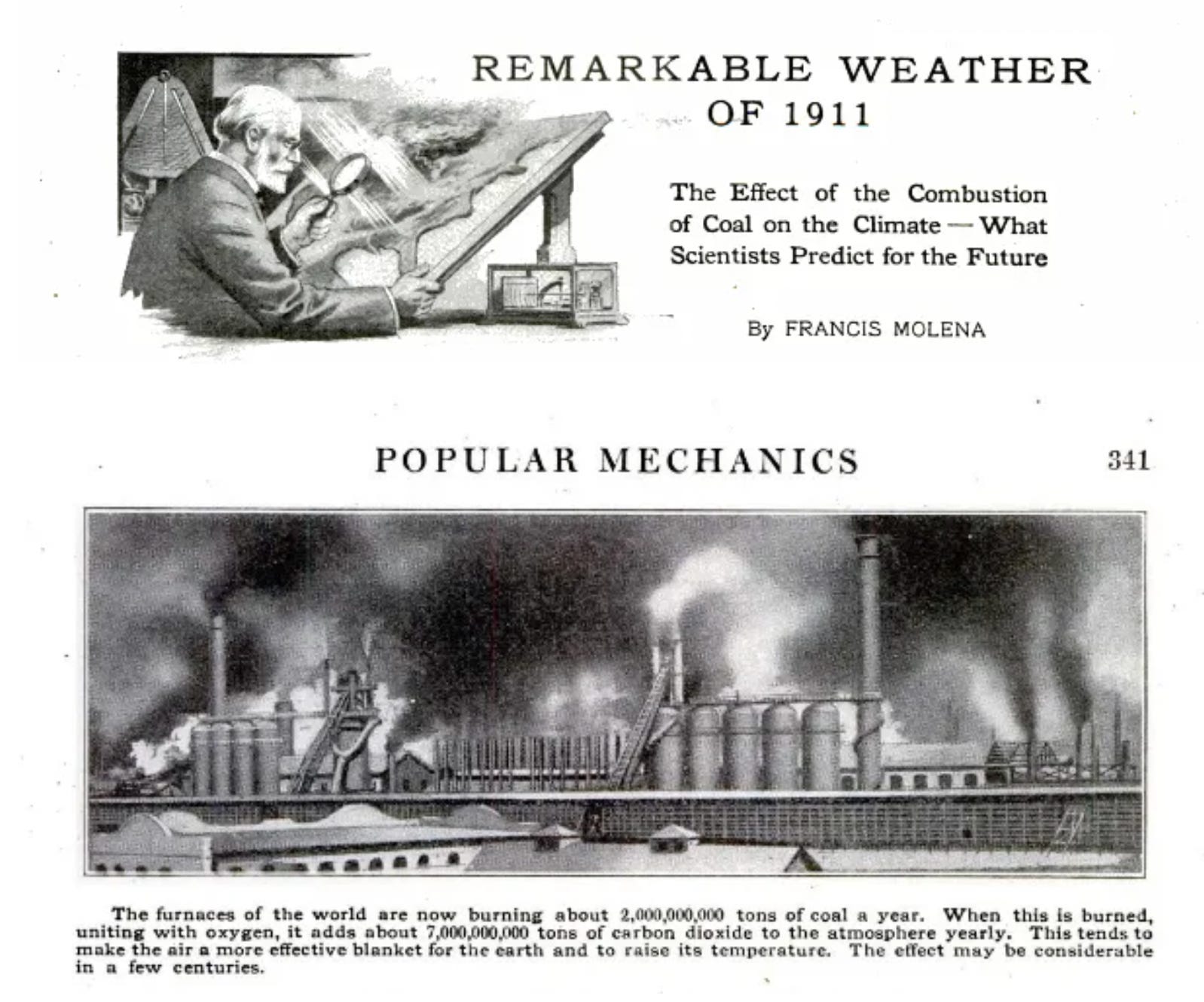
I came across an article from the March 1912 issue of Popular Mechanics, noting way back then that the effect of adding carbon dioxide to the atmosphere in large quantities “may be considerable in a few centuries.” Called it!
Full original issue at this link.
LINKS
For a great history of the Emperor Justinian’s improbable rise from a peasant family to one of the most consequential Roman rulers, I recommend this 3-part podcast series from historians Tom Holland and Dominic Sandbrook.
Velina Tchakarova, “Enter the ‘DragonBear’: The Russia-China Partnership and What it Means for Geopolitics,” https://www.orfonline.org/research/enter-the-dragonbear-the-russia-china-partnership-and-what-it-means-for-geopolitics
Here’s an excellent social media commentary on the personal dimensions of the Russia/Putin-China/Xi relationship from Dr. Junhua Zhang of the European Institute for Asian Studies in Brussels: https://www.linkedin.com/posts/dr-junhua-zhang-%E5%BC%B5%E4%BF%8A%E8%8F%AF-93a89123_in-the-west-it-has-been-a-quite-popular-ugcPost-7232709884134252544-d5IG
“Ukraine’s Kursk Offensive Blitzed Russia With Electronic Warfare And Drones:” https://www.forbes.com/sites/davidhambling/2024/08/09/ukraines-kursk-offensive-blitzed-russia-with-electronic-warfare-and-drones/
“Our Oppenheimer moment’ — In Ukraine, the robot wars have already begun”, Politico: https://www.politico.eu/article/robots-coming-ukraine-testing-ground-ai-artificial-intelligence-powered-combat-war-russia/
Uekoetter F. The Green and the Brown: A History of Conservation in Nazi Germany. Cambridge University Press; 2006: https://www.cambridge.org/core/books/green-and-the-brown/3630367CE6E569B0D1931173C91C947E
To learn more about ‘tension points’ and the value of noticing asymmetries from a social science perspective, I enthusiastically recommend: Flyvbjerg, B, Landman, T and Schram, S, “Tension Points: Learning to Make Social Science Matter” (2016): https://ssrn.com/abstract=2721321