Global Sync #8
We're back! - Why I Write | The Storm | Strategic Empathy | Warren Zevon | A Thank You | Pirate Dinghies
Dear Reader,
We’re back! As you may have noticed, I took a little break from writing the past few months, at first for practical/logistical reasons and then to allow for some deeper reflection on exactly why I’m writing this newsletter and why anyone should read it. As a welcome back, I’m sharing a few of these thoughts. I’ve also added a few small features to make the newsletter more readable and interesting. Thank you for reading!
Global Sync #8
Today is the 11th of August, 2024. Here are 5 things I think are worth knowing about the world this week.
1/ IDEAS: Why I Write
What I most wanted to do…is make political writing into an art. - George Orwell, 1946, ‘Why I Write’
The world, it is clear now, is not going back to the way it was. Events that would have been historically significant a few years ago now happen on a weekly basis. Bedrock assumptions about the order of things are objectively changing in front of our eyes.
My immediate utilitarian goal with this newsletter is to provide readers digestible and actionable knowledge about a world in flux. On a deeper level, however, my intention is to look for more basic and powerful truths about the world today, who we are and who we want to be as people and as nations on a shared planet. Truths that reveal themselves sometimes through analysis of the big geopolitical events of the day but just as often through history, art, literature and philosophy, travel and business, and science and the natural world. Truths that show how the volatility we are and will be experiencing can be just as liberating as it is alarming. Truths that transcend ephemeral memetic divisions like 'sustainability,’ 'security,’ or the 'market.’
A great irony of History is that times of chaos are also times of equally profound innovation and imagination, adaptation and liberation. But how do we harness the positive potential of our age? The answer is not straightforward. I believe it starts though by going back to basics, to our foundations as civilizations and as living moral humans.
It’s on the strength of those foundations that we can move forward and challenge that which limits us and our ability to understand and interact with a new world that is, as Gramsci said for an earlier era, struggling to be born. We don’t know what the future will bring. But what is certain is that we will need to dig deep and determine for ourselves - unmediated by the dying philosophies and irrelevant old men who led us to this place - what we want a new world to look like and how we want to relate to it. By seeking out and understanding where we have come from, we will not only be prepared for whatever comes next but be able to envision and create better and more just futures for our nations and our planet, and ourselves.
We live in a violent, tumultuous, revolutionary age. Even darker times may lay ahead. I’m writing this newsletter to help readers – and myself – engage this new world without fear.
2/ ART: The Storm
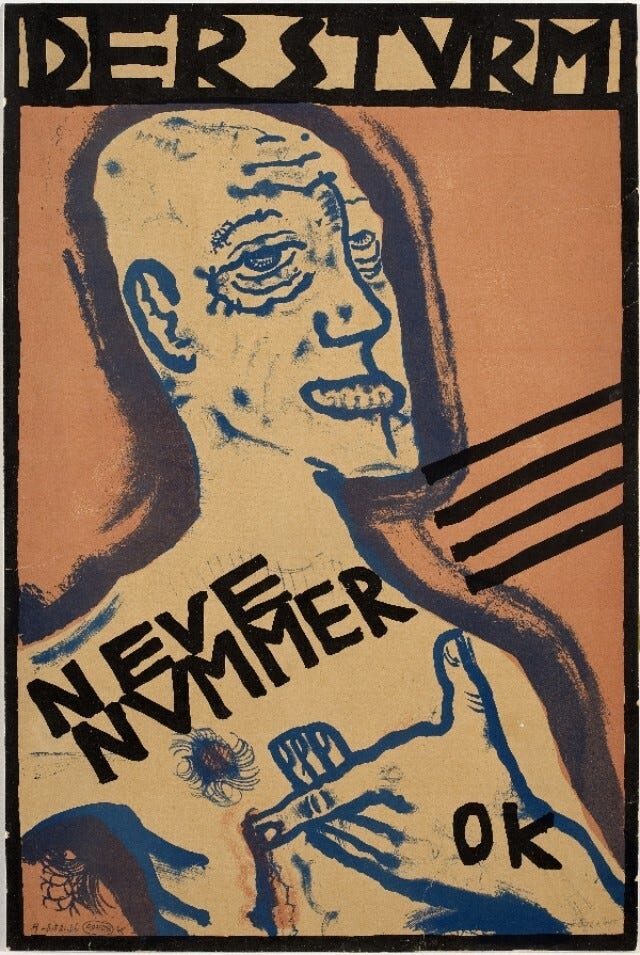
My family and I went to the Belvedere museum in Vienna last month and came across one of the original copies of Der Sturm (‘The Storm'), the avant-garde magazine that ran from 1910 to 1932. Der Sturm was not just a magazine but the center of gravity for a physical community of artists and thinkers transcending enemy lines during the chaos of World War I. It was eventually put out of business, with many of its featured artists later persecuted as ‘degenerate’ under the Nazi regime.
Here’s to all the ‘degenerates’ out there still creating art and building communities across boundaries. I think we’re due for a mini-Renaissance of both art and community building in the coming years.
3/ IDEAS: Strategic Empathy
When I was doing my PhD on the anthropology of how terrorists do business around the world, one of my favorite books was a long essay by John Gray called “Al Qaeda and What it Means to be Modern.” Gray’s work is perceived as dark and depressing by many, but I think he is actually a champion of humanity, in all its beautiful complexity and contradictions. Being comfortable with this reality grants us a gift, what I like to call Strategic Empathy. A special power that allows us to understand humans and peoples as they are, on their own terms - and then use that knowledge not for mere childlike sympathy but to take action for a future we care about. Know your friends. Know your enemy. Know yourself.
“Can we not accept that human beings have divergent and conflicting values, and learn to live with this fact? It is a strange notion that humanity is destined for a single way of living, when history is so rich in conflict and contrivance.” - John Gray
4/ MUSIC: Warren Zevon
I love Warren Zevon. Twenty years after his death, his music is still fresh. I think this is because his songs barrel head-on into the world’s eternal chaos. He sings about mercenaries, wars, betrayals, innocent bystanders, and how one’s own sense of morality doesn’t need to fit neatly into whatever geopolitical or ideological waves are currently sweeping over us.
“Send lawyers, guns, and money. The shit has hit the fan.” - Warren Zevon
Now is a great time to get back into him if you’re already a fan, or check out his catalog if you’re not. Here’s a comprehensively hairy live version of one of his classics to get started.
5/ EDITORIAL: A Thank You
A writer’s subject-matter will be determined by the age he lives in – at least this is true in tumultuous, revolutionary ages like our own. - Orwell, 1946
I started this newsletter as an experiment, to ‘make geopolitics simple’ in a time of profound change. So far I am honored and thankful for the great response to this little experiment. Going into the 8th issue, we’ve gone from absolute zero to several hundred subscribers, with a diverse and what can only be described as a high quality readership. Among this committee of correspondence, we have serving generals and former foreign ministers, students and professors, filmmakers and artists, bankers and lawyers, environmentalists and humanitarians, and many others just interested in some critical thinking for our critical times.
Here are a few of the kind things readers have said about what we’re doing here:
I subscribed to your newsletter (love it) and read it religiously.
I'm really enjoying reading the Global Sync series, as there are a lot of subjects I would have passed by otherwise.
I’m really loving the newsletter. Keep em coming!!
I like very much the fact that it highlights topics that are under-discussed.
Love the substack and I’ve reposted it into a couple of groups I think will like it. I’m really looking forward to reading more of these.
I love your Global Sync newsletters. They are fantastic!
Thanks for the newsletters. Definitely making me smarter!
This is great! Love it.
Thank you, dear Reader, for joining me and I encourage you to spread the word to people who might want to subscribe, write to me directly, or post a comment.
INSPIRATION: Pirate Dinghies
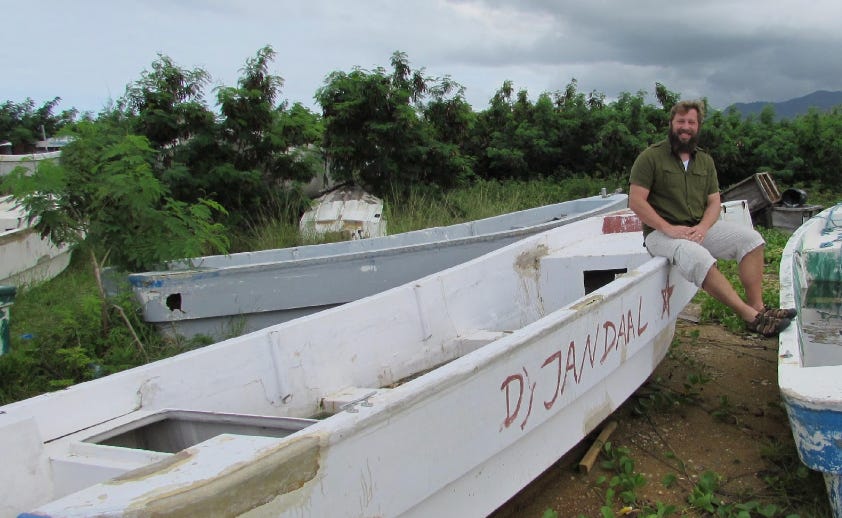
Here’s me at work back in the day, at a Somali pirate ship boneyard where captured pirate vessels were kept. I came across this photo recently and thought it contained a great metaphor for our place in the world today.
I think that as long as we are willing - as individuals and collectively - to occasionally seek our fortune out in the open ocean in a rickety old dinghy, humanity will be fine.
LINKS
“Why I Write” by George Orwell, https://www.orwellfoundation.com/the-orwell-foundation/orwell/essays-and-other-works/why-i-write/
Prison Notebooks, Antonio Gramsci, https://cup.columbia.edu/book/prison-notebooks/9780231060820
Der Sturm, https://monoskop.org/Der_Sturm
Degenerate Art, Why Hitler Hated Modernism https://www.bbc.com/news/magazine-24819441
The Belvedere Museum, Vienna, https://www.belvedere.at/en
Al Qaeda and What it Means to be Modern by John Gray, https://thenewpress.com/books/al-qaeda-what-it-means-be-modern
Committees of Correspondence, Mount Vernon Library, https://www.mountvernon.org/library/digitalhistory/digital-encyclopedia/article/committees-of-correspondence